The Classic Software Developer Is No Longer Needed
I know that is a bold claim. And I make it as someone who spent years developing software and guiding development projects. But after the first projects at Schoeberli GmbH I am convinced: the classic role of "the developer who writes code" has lost its purpose.
At Schoeberli, every staff role is handled by AI – by Claude, to be precise. Not as an experiment, but as an operating model. What is remarkable is not how much code this produces. It is how little of it is the actual bottleneck.
Coding is no longer the hard part
Anyone working with Claude Code today notices quickly: implementation is solved. A cleanly described feature, a clear interface, a defined data structure – that takes minutes instead of days. Refactorings, test coverage, migrations, documentation: all tasks that used to tie up weeks of developer capacity and now simply run alongside.
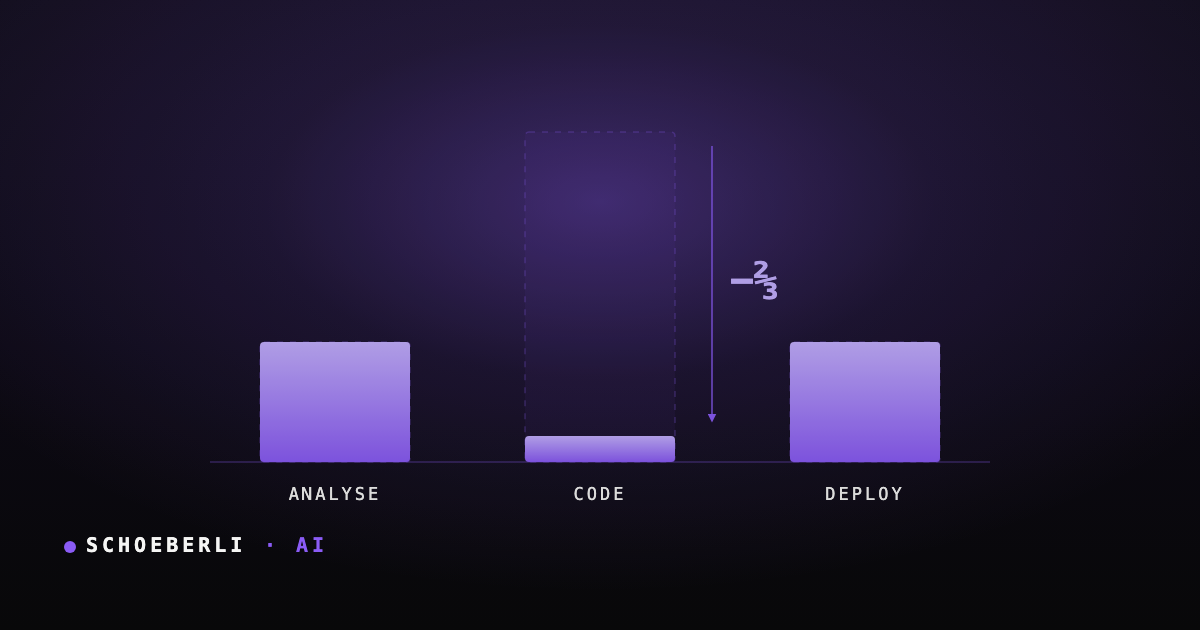
The bottleneck has moved. In our projects the real work sits in exactly two places: in the business analysis and in the deployment.
The business analysis is not always straightforward, because existing processes have often grown organically or are documented imprecisely. What happens in an edge case? Which rule genuinely applies, and which one is merely a historical leftover? No AI answers these questions on its own – they emerge in conversation, in understanding a business, in probing at the right spot. Cut corners here and you very quickly get a great deal of code that delivers no value.
Deployment is hard as well, because that is where reality is waiting: operations, data protection, security, permissions, or interfaces to systems nobody really knows anymore. And the responsibility for something running in production – and still running tomorrow morning – is a part you cannot automate away, because it does not consist of code but of decisions.
The work does not disappear – it shifts
That is precisely why the claim needs sharpening. What disappears is the role whose contribution consisted of translating requirements into syntax. What remains, and becomes more important: understanding, specifying, questioning, reviewing, taking responsibility.
The best people in this new model are not the fastest programmers, but those who can penetrate a subject matter properly and judge a result critically. Someone who recognises that a generated solution is technically correct but factually wrong is worth more today than someone who would have typed the same solution by hand.
This is also why many of our development projects grow out of a consulting mandate. First we understand the business and the target architecture, then we build. In that order – not the other way round.
What this means for clients
The economic effect is considerable. I am convinced that on classic development projects we can cut the investment on the client side by roughly two thirds.
That saving does not come from us working more cheaply. It comes from the fact that a large share of the classic effort simply falls away: the implementation phase itself, setting up boilerplate, the coordination loops in large teams, the retrofitting of documentation and tests. What remains is the effort for analysis, decisions and go-live – and compared with the past, that is the smaller part.
Where it does not work
What does not work: one person installs Claude Code and assumes that great software will now appear by itself. It is not that simple. It always takes an end-to-end view – from the business analysis through implementation to deployment. That includes determining the target infrastructure, and above all the operations and maintenance that follow. Cover only the middle part and you have not delivered a project, you have built a prototype.
What this looks like in practice
Theory is one thing. In the next article we will look at Pecugate.com – the first project delivered entirely with Claude by Schoeberli GmbH. From the first business analysis through implementation to production operation, including the points where it got sticky.
Do you have a project that has so far failed on time or budget? Talk to us.